


It's Not the Tools — It's the Missing Ownership
Industry analysts and practitioners note that systems integration projects rarely fail because of APIs or middleware; they fail because there is no clear project management and accountability. A veteran project manager writing for the Project Management Institute observed that integration projects are "doomed before they start" when organisations neglect proper project management and control techniques. Many teams don't identify the main objective, allow scope to creep and fail to assign a single leader with authority. Without weekly status reports and time control, integration work drifts, deadlines slip and everyone assumes someone else is watching for failures.
Enterprise CRM practitioners echo this sentiment. Codeless Platforms' 2026 integration guide warns that organisations often expand integration organically "in response to urgent requests," creating "integration drift" where no one defines scope or ownership. When marketing, sales and finance each build their own connectors, no team can troubleshoot end‑to‑end flows because there is no shared operating model.
Common Failure Patterns
Lack of ownership shows up in predictable patterns:
- Treating "connected" as "governed". A connector or direct API call moves data, but doesn't guarantee consistency, monitoring or security.
- Letting every team build its own integration style. Sales ops uses one connector, finance uses another and marketing uses a native sync. There's no shared operating model, so troubleshooting becomes guesswork.
- Ignoring rate limits or schema changes. A single high‑volume workflow can exhaust CRM API quotas, causing unrelated processes to slow down or fail.
- Chain dependencies. Point‑to‑point integrations seem simple until one data sync triggers a chain: CRM updates pricing → ERP updates fulfilment → customer portal updates.
Building an Ownership‑Driven Integration Strategy
Define Scope and Sources of Truth
Integration strategy succeeds or fails based on how well stakeholders define scope, priorities and ownership. Start by classifying platforms:
- Systems of record are authoritative sources—e.g., ERP for revenue recognition or CRM for pipeline and customer relationships.
- Systems of engagement handle interactions with customers or teams—e.g., marketing automation, service desks or CPQ systems.
- Systems of intelligence aggregate data for analytics or AI—e.g., data warehouses and forecasting models.
Once you know which system owns the truth for each entity, assign integration tiers (revenue‑critical, operational or informational) and timeliness requirements (real‑time, near‑real‑time or batch).
Adopt Standard Architecture Patterns
Point‑to‑point connections encourage sprawl and make integrations fragile when volumes grow or new systems are introduced. Mature organisations standardise on a combination of hub‑and‑spoke, event‑driven and API‑led patterns:
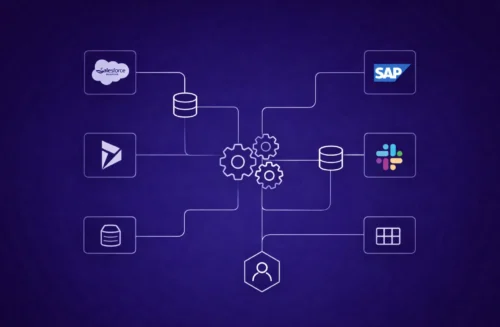
- Hub‑and‑spoke (integration hub) centralises logic and routing. Systems do not depend directly on each other; they publish to or consume from the hub.
- Event‑driven integration triggers workflows from business events (lead created, deal closed, order shipped). This reduces polling and improves scalability.
- API‑led integration exposes reusable interfaces through controlled endpoints rather than direct database access or brittle custom code.
Govern Data Models and Mapping
Integration isn't just about moving data; it's about ensuring data means the same thing everywhere. Most data issues arise from unclear ownership, inconsistent definitions and uncontrolled transformation logic. A pragmatic governance model assigns owners for customer identity and revenue status and defines mapping and validation standards.
Orchestration: The Brain of Cross‑System Processes
Microservices, Orchestration and Choreography
As enterprises adopt microservices, integration challenges multiply. Two coordination styles address these challenges:
- Orchestration uses a central orchestrator to manage interactions between services. The orchestrator handles tasks such as service discovery, load balancing, fault tolerance, scalability and monitoring.
- Choreography is a decentralized pattern where each service is responsible for coordinating its own interactions with other services, communicating through standardized events.
In practice, enterprises often combine orchestration and choreography. Use orchestration for complex, long‑running workflows that require coordination and choreography for simple, decoupled event flows.
Best Practices for Orchestrating Microservices
- Use containerization platforms like Docker or Kubernetes to simplify deployment and ensure consistency across environments.
- Implement a service registry to track available microservices and simplify service discovery.
- Perform health checks for fast failure detection.
- Use circuit breakers to prevent cascading failures.
- Adopt event‑driven architectures with message brokers like Kafka or RabbitMQ to decouple services and enable asynchronous communication.
- Monitor and log each microservice to track performance and provide insight into system health.
From Integration to Orchestration: A Holistic Approach
A holistic integration strategy includes the following elements:
- Ownership and Governance: Define systems of record, engagement and intelligence; assign integration tier owners; maintain canonical models; manage schema changes through versioning.
- Standard Architecture Patterns: Use hub‑and‑spoke for central orchestration, event‑driven integration for scalable decoupling, and API‑led integration for controlled interfaces.
- Service Orchestration: For microservices and complex workflows, adopt orchestration tools to manage deployment, scaling, fault tolerance and service discovery.
- Automation and Monitoring: Implement platforms that centralize integration logic, enforce mapping rules and provide monitoring, retries and alerts.
- Security and Compliance: Adopt consistent authentication, authorization and encryption standards across all integration points.
- Continuous Improvement: Integration and orchestration are never "finished." Establish feedback loops with business stakeholders, monitor SLAs and error rates, and iterate.
Conclusion: Your Integrations Don't Fail — Ownership Does
Integration fragility is rarely about protocols or middleware; it is about people, process and ownership. Without clear objectives, roles, governance and monitoring, even the most advanced technology will produce unpredictable failures. To orchestrate cross‑system processes without fragility, enterprises must treat integration as a product, not a one‑off project.
By adopting standard architecture patterns, microservice orchestration, and robust governance models, organisations can build resilient, scalable integrations. And they should remember that technology choices are secondary to cross‑functional ownership and accountability.

