


Introduction
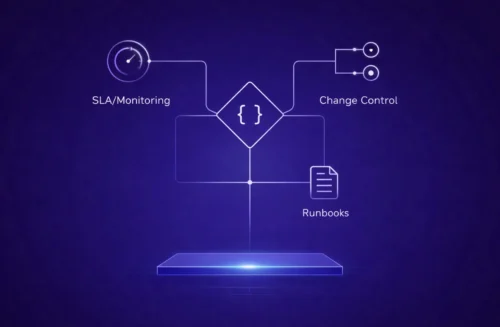
Modern enterprises have discovered that the go‑live date for an integration platform or workflow layer is not the finish line but the starting line. Deploying a process orchestration engine is just the first step; the real challenge is keeping it running reliably, safely adapting it over time, and aligning it with business outcomes. Service level agreements (SLAs) are no longer static documents negotiated once a year — they become a living operating system that drives alerts, escalations, runbooks and accountability.
What "operating a workflow layer" actually means
When companies adopt workflow engines they often think about integration in terms of pipelines and connectors. In reality, operating a workflow layer is a long‑running activity. Workflows can span days or weeks and involve human approvals, external API calls and state transitions. The integration layer must coordinate these activities reliably across distributed systems.
Operating the workflow layer means:
- Maintaining state across long‑running processes. Stateful orchestration platforms track inputs, outputs and the call stack, enabling durable execution that can resume after outages.
- Managing retries and compensations. Failure is normal in distributed systems; networks drop packets and services temporarily become unavailable. When failures cannot be fixed by a retry, workflows must perform compensating transactions to undo work done by previous steps.
- Handling stuck states and silent failures. Operational leaders often do not have real‑time visibility into what is currently stuck. Real‑time visibility allows teams to spot stuck cases immediately and reroute them.
- Integration with the broader operations model. The reliability of workflows depends not only on the orchestrator but also on external services, data pipelines and human task owners.
Defining SLIs/SLOs for processes: cycle time, stuck cases and failure rates
An SLA is the contractual promise made to customers (e.g., 99.9% uptime), while an SLO is an internal reliability target, and an SLI is the actual measurement. For a workflow layer, process‑level indicators are more useful:
- Cycle time / lead time: The percentage of workflow instances completed within a target time window (e.g., "95% of loan approvals are processed within 24 hours").
- Stuck case ratio: A useful SLI counts workflow instances that remain in a state longer than a predefined threshold. An SLO might set a goal of "less than 2% of cases are stuck for more than two hours."
- Failure rate / error ratio: For workflows, failure rate can measure the percentage of instances that terminate unsuccessfully or require manual intervention.
- Retries / compensation count: Because retries and compensating actions are core to reliable workflows, tracking how often they occur helps gauge stability.
- State transitions / backlog: A sudden increase in backlog may signal downstream slowness or misconfigured resource limits.
Building SLOs and error budgets
After selecting SLIs, set SLO targets that balance reliability and agility. Error budgets translate SLOs into action: if the error budget is burning too quickly, pause feature releases and focus on reliability.
Runbooks: the three most common incident types
Incidents will happen. The difference between a minor blip and a prolonged outage is often the preparedness of the on‑call team and the quality of the runbook they follow. Below are three common incident types in workflow operations.
1. External service failure (dependency outage)
Workflows often depend on third‑party APIs (e.g., payment gateways, identity verification services). When a dependency is down, workflows may enter retry loops or become stuck. The runbook should:
- Detect: Alert when retries exceed a threshold or when a dependency's status page reports an outage.
- Diagnose: Query the dependency's status page or API, check recent deployments, and inspect logs.
- Mitigate: Pause new workflow starts for the affected step and route requests to an alternative provider if possible.
- Rollback / compensate: If partial work has been performed, execute compensating transactions to undo the side effects.
2. Stuck or long‑running workflows
Stuck workflows occur when they wait indefinitely for human input or external events. Runbooks for stuck cases should:
- Detect: Alert when a workflow instance remains in the same state beyond its expected time.
- Diagnose: Identify whether the stuck state is due to missing input, resource limits, or a bug.
- Mitigate: Manually progress the workflow if safe, or restart the step with the same idempotency key.
- Prevent: Add timeouts and escalation triggers so that if a human approval is not completed within a certain period, the case is automatically reassigned.
3. Versioning or rule change gone wrong
Even with careful testing, new rules or workflow versions can introduce unexpected issues. Runbooks should anticipate version‑related incidents:
- Detect: Monitor deployments and observe if there is a sudden spike in incompatible workflow instances or errors after a version change.
- Diagnose: Determine whether the new version includes breaking changes.
- Mitigate: If conflicts occur, decide whether to abort, restart, or mark the instance as resolved.
- Rollback / feature flag: Use version control and feature flags to disable a new rule without rolling back the entire application.
Change control: updating rules/processes without breaking the core system
Frequent changes are the norm in modern software, but uncontrolled changes in a workflow layer can wreak havoc on running processes. An effective change control strategy includes versioning, safe deployment techniques, automated testing, and rollback plans.
Versioning and documentation
Versioning allows teams to work on different segments simultaneously and facilitates quick rollbacks for service reliability. Adopting a consistent versioning scheme (e.g., semantic versioning), using version control systems, documenting the versioning policy, and automating versioning in CI/CD pipelines ensures that every change is traceable.
Safe deployment patterns
- Canary and blue/green releases. Deploy new workflow rules to a small subset of instances or a separate environment. Only promote when metrics show healthy performance.
- Feature flags. Wrap new logic behind a configuration flag so that you can quickly disable it if error budgets are consumed.
- Validation and conflict detection. For platforms that support it, implement a schema migration strategy: avoid deleting or altering fields used by running instances.
- Automated testing and observability. Use automated tests to replay historical workflow traces against the new version and catch regressions.
Ownership model: who owns what
A workflow layer sits between business processes and IT systems, so ownership must be clear. Key roles include:
- Primary on‑call engineer: Handles initial incident response, acknowledges alerts and initiates mitigation.
- Secondary on‑call (escalation engineer): Steps in when incidents surpass the primary engineer's expertise.
- IT managers and program leaders: Oversee schedules, track performance metrics and balance operational needs.
- DevOps/SRE teams: Maintain system stability and reliability during incidents.
On the business side, process owners must define SLAs and SLOs that reflect customer expectations. IT teams translate these into technical indicators and implement monitors. Vendors own platform reliability and the ability to deliver on their contractual SLA.
Bringing it all together
A functioning workflow layer is the backbone of modern operations. Achieving reliable operation requires treating go‑live as the beginning of an ongoing operations journey:
- Treat SLAs as an operating system. Define SLIs that reflect process outcomes, set SLOs that balance reliability and agility, and build alerting and escalation mechanisms around them.
- Prepare runbooks for common failure modes. Anticipate external service outages, stuck workflows, and versioning issues. Keep runbooks scannable and actionable, and test them regularly.
- Implement disciplined change control. Use versioning schemes, feature flags and safe deployment patterns; validate changes against running workflows; and design compensating transactions that are idempotent and resilient.
- Establish a clear ownership model. Define roles across business, IT and vendors; map severity levels to responsibilities; and standardise escalation stages.
Operating a workflow layer is a continuous journey of measuring, learning and adapting. When you treat SLAs as living systems, design for failure, and embed change control and ownership into your daily practices, the integration layer becomes not only a reliable core but also an engine for innovation.

